Merge Inn - Cafe Merge Game
- 4.5
- Rating
- 10.00M
- Installs
- Free
- Price
 Analysis by App-foxy
I spent time with Merge Inn as a puzzle game that mixes combining objects with running a food business. That combination gives it a different rhythm from a standard match-three title: instead of clearing a board in quick bursts, I worked toward ingredients, dishes, and restaurant progress through a more gradual chain of decisions. It is free to start, rated for Everyone, and comes from Original Games Pte. Ltd., so it is easy to approach as a casual game for short breaks rather than a demanding strategy project.
The central question is not whether it is attractive in the abstract. The more useful question is whether you enjoy a puzzle game that asks you to organize a board, wait for opportunities, and connect food preparation with a longer restaurant-building journey. I found that the answer depends heavily on how much patience you have for limited space and repeated merging. If you like watching small resources turn into something more valuable, this can be a relaxing choice. If you want constant action or puzzles with a single correct solution, another type of game may suit you better.
How I judged the game before recommending it
For me, the first decision criterion was the basic loop. Merge games can look simple, but the quality comes from how well the board creates meaningful choices. In this case, I paid attention to whether I was merely combining items automatically or actually deciding what deserved space, which requests to prioritize, and when it was worth holding onto a lower-level object. The restaurant theme matters because it gives those actions a purpose beyond making a larger item.
You May Also Like

 Blood Strike: 2.5 Anniversary
Blood Strike’s Loadouts Turn Every Drop Into a Tactical Gamble
A close look at Blood Strike’s custom loadouts: how fast access to signature weapons reshapes its battle royale rhythm, rewards preparation, and narrows the gap between fights.

 Pandora - Music & Podcasts
Pandora’s Music Is Easy to Start, but Harder to Recover
Pandora’s strength is its low-effort path from a seed to a station. Its weak spot is how much confidence it asks you to place in connection, setup, and quiet recovery.

 8 Ball Pool
 Is Built on Rivalries, Rematches, and Routine
A close look at the rivalries, rematches, shared routines, and unanswered safety questions that turn a quick pool match into a persistent mobile community.

 Samsung Music
’s Quiet Strength Is Playing What You Already Own
Its reach comes less from spectacle than from dependable access to a personal library. That simplicity is both the app’s strongest retention engine and its ceiling.

 AccuWeather: Weather Radar
AccuWeather Review: A Quick, Clear Forecast for Everyday Decisions
For everyday plans, the best forecast is the one you can understand quickly. AccuWeather makes rain timing, radar, and local conditions easy to act on, with a few trade-offs.

 Hill Climb Racing
Why Hill Climb Racing Still Turns Crashes Into One More Run
A tiny car, a bumpy hill and one more upgrade: Hill Climb Racing keeps resurfacing because its simple chaos makes every near-miss feel personal.
More From Our News Desk
View All News


The second criterion was how the game fits into ordinary life. I tested it mentally as the kind of title I would open while waiting for an appointment, taking a short break, or winding down before bed. A game in this category needs to communicate its next step clearly without demanding a long uninterrupted session. It also needs to avoid making every pause feel like a failure. Merge Inn generally works well in that role because its progress is built around small actions rather than a single extended challenge.
I also considered how much pressure comes from the board itself. Merge puzzles often become less comfortable when the available space fills up. That is not automatically a flaw; limited room can create the best decisions. However, there is a difference between thoughtful pressure and clutter that forces unnecessary waiting or spending. My experience was that the board encourages planning, but players who dislike managing temporary objects may find the same system tiring.
Finally, I looked at value and commitment. The game is free, while optional purchases range from $0.49 to $99.99 per item. That wide range makes it important to decide early whether you are comfortable playing at a relaxed pace without buying anything. I would approach it as a free casual game first, not as a purchase that guarantees a faster or more complete experience.
The merge board rewards planning more than speed
The most satisfying part is the way a modest item can become useful after several combinations. I learned not to merge every matching object immediately. Sometimes keeping separate pieces on the board gave me more flexibility, especially when I was trying to respond to more than one food-related request. A quick merge can make the board look cleaner, but it can also remove the exact intermediate item you need a moment later.
My practical advice is to treat open spaces as a resource. Before combining something, I would scan the board and ask whether the result will help with an active goal or simply create another object that needs storage. This small habit makes the game feel more strategic and reduces the frustration of filling the board with items that are technically useful but not useful right now.
Another useful approach is to separate immediate tasks from long-term progress. When I focused only on the next request, I sometimes made choices that slowed the larger chain. When I focused only on a distant upgrade, I could lose the short-term rhythm that makes the game rewarding. Alternating between the two works better: finish a manageable request, then use the resulting space or reward to prepare for a more ambitious chain.
The restaurant layer gives the puzzles a reason to continue
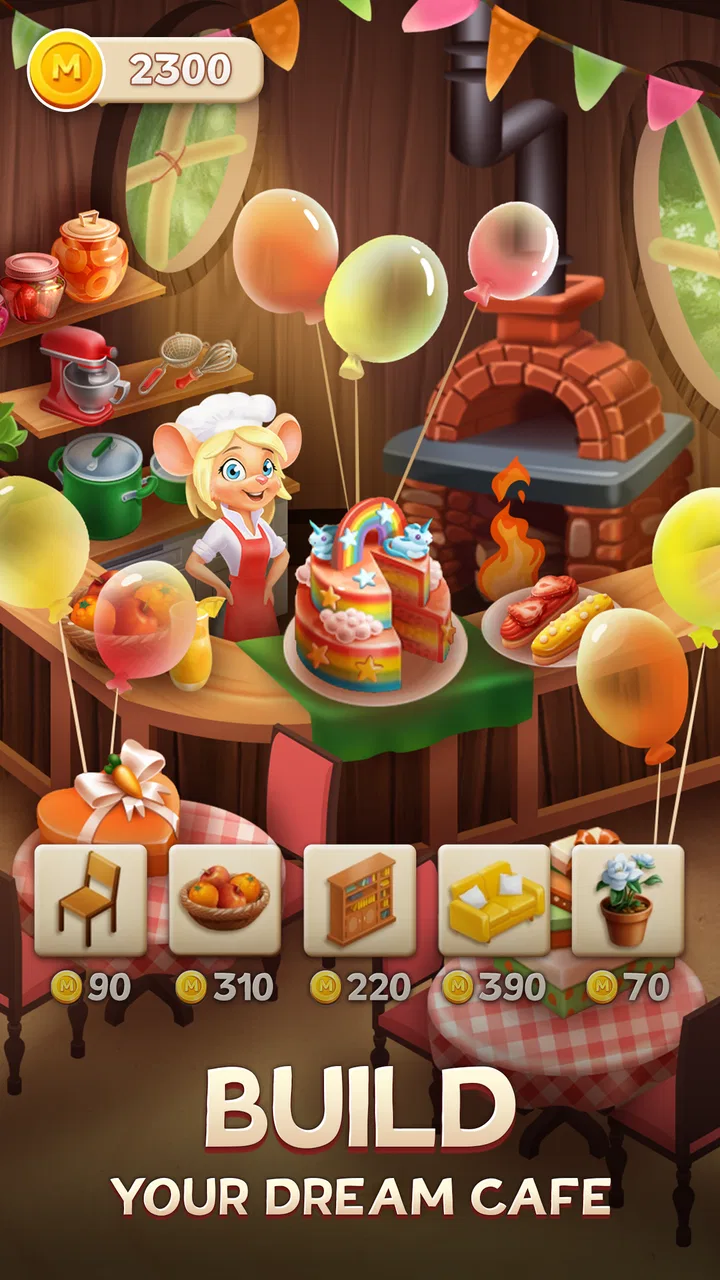
The food setting is more than decoration in the way I experienced it. Merging is tied to serving dishes and developing a dream restaurant, so the board has a clear narrative direction. That helps the game avoid feeling like an endless row of disconnected combinations. Even when an individual merge is small, it contributes to the feeling that the restaurant is moving forward.
I particularly liked this structure for relaxed sessions. A pure merging game can become abstract after a while, while a restaurant-management game can sometimes become too focused on timers, upgrades, or optimization. Here, the two ideas soften each other. The puzzle board supplies the hands-on activity, and the restaurant goal supplies motivation.
There is a trade-off, though. Players who want deep restaurant simulation may find the business theme lighter than the title suggests. I would not choose this expecting detailed staffing, menu economics, or a complex management model. Its restaurant identity is mainly a progression framework around the merging activity, and that is a strength if you want simplicity but a limitation if you are looking for a full management game.
Why the game has broad casual appeal
The Everyone content rating makes the game approachable for a wide audience, and the controls are easy to understand without a long learning period. I could imagine recommending it to someone who enjoys organizing objects, completing small goals, and seeing visual progress without needing fast reflexes. It is also a reasonable fit for players who find traditional competitive puzzle games stressful.
The game has reached over 10 million installs and holds a 4.5 average from around 293 thousand ratings, which matches my impression that its basic idea is easy for many people to pick up. Those figures do not guarantee that every player will enjoy the pacing, but they do suggest that the merge-and-restaurant combination has a substantial audience.
It is also relatively accessible from a device perspective. The current version is 8.6 and it supports devices running Android 8.1 or later. For someone using an older Android phone, checking that requirement before installing is sensible. On a compatible device, the game is positioned as an easy entry point rather than a specialist puzzle experience.
Where Merge Inn stands out from familiar puzzle choices
Compared with match-three games, this title is slower and more spatial. A match-three board usually asks me to identify a move and make it immediately. Here, the important decision may be whether to wait, preserve an item, or use a limited space for a different chain. That makes the game less about reflexes and more about inventory-style thinking.
Compared with hidden-object games, the satisfaction comes from transformation rather than discovery. I am not mainly searching a fixed scene for a cleverly placed object. I am building toward a result through combinations. That is a better fit for players who enjoy visible progression, but it may feel repetitive to someone who prefers a new visual puzzle in every round.
Compared with traditional restaurant games, the emphasis is reversed. The food and restaurant theme provide context, while merging does most of the mechanical work. I would recommend a dedicated restaurant simulator to someone who wants to balance menus, staff, customers, and finances. I would recommend this game to someone who likes the fantasy of improving a restaurant but wants the actual play to remain a puzzle exercise.
Against minimalist merge games, the restaurant layer gives the player more emotional direction. A simple merge board can be calming, but it may eventually feel like a spreadsheet of objects. The food-serving setting helps each chain feel connected to a larger destination. The cost is that players who prefer a clean, abstract board may find the extra theme unnecessary.
A realistic everyday session
Imagine opening the game during a fifteen-minute lunch break. I would first check the current requests, look at the crowded areas of the board, and decide whether the next few merges can finish something useful. I would avoid spending the entire break chasing a long chain if it meant blocking the board. Instead, I would complete a smaller objective, clear a little room, and leave the game with a clear next step.
That is where the game feels most comfortable to me. It does not require the player to treat every session as a major event. A few deliberate moves can still feel productive. If you have only a short amount of time, the best habit is to enter with one purpose rather than trying to solve every request at once.
Longer sessions reveal the main weakness. Once I had been managing the same kind of board for a while, the decisions could start to feel more like housekeeping than discovery. The game is strongest when I am making a meaningful choice between several possible uses for space. It is weaker when the next action is obvious but still requires several repetitive combinations.
Small decisions that improve the experience
One of my most useful habits was leaving a buffer of empty space instead of treating every open square as an invitation to create another object. That buffer gives room for unexpected rewards and prevents a successful chain from becoming awkward simply because there is nowhere to place the result. It also makes the board easier to read at a glance.
I would also avoid judging progress only by the largest item visible. A lower-level object can be more valuable if it completes a current request or opens a useful route. Chasing impressive combinations can be tempting, but the restaurant progression often feels smoother when I balance ambition with practical deliveries.
When the board becomes crowded, I found it helpful to pause rather than merge randomly. A few seconds spent identifying duplicates, unfinished chains, and objects that serve no immediate purpose can prevent several poor moves. This is a small difference, but it changes the game from tapping through clutter into making a plan.
Where another game may be the better choice
I would not pick this for someone who wants a pure logic puzzle with carefully designed levels and a definite solution. The appeal here is ongoing progression and resource organization, not the satisfaction of proving one answer correct. A dedicated logic game will usually provide sharper mental challenges and less dependence on a long-term board.
I would also steer competitive players toward a title with timed matches, leaderboards, or direct challenges. Merge Inn is better suited to personal progress. Its relaxed structure is useful when I want to play without pressure, but it does not replace the excitement of competing against another person.
Players who dislike waiting, repeated combinations, or optional purchase prompts should think carefully before committing. The game is free, but its in-app purchase range reaches from small amounts to $99.99 per item. I would disable purchasing on a shared device or set a clear personal rule before playing, especially if a younger player will use it. The Everyone rating describes the content audience, not a promise that every spending decision will feel comfortable for every household.
There is also a genre trade-off for people who want a complete restaurant fantasy. If your ideal game is about designing a dining room, controlling staff, and reacting to customer behavior, a management-focused alternative will probably offer more depth. This one is for the player who wants the restaurant atmosphere wrapped around a merge board, not the other way around.
What it costs to change your expectations
The main cost of switching into this game is learning to value preparation over immediate action. Someone coming from match-three puzzles may initially wonder why a move that looks productive is not always the best move. The board asks for a different mindset: keep options open, protect space, and accept that a small step can be better than a dramatic combination.
The cost of switching away is equally clear. If you leave for a pure puzzle game, you may gain more concentrated brainteasers but lose the ongoing restaurant motivation. If you move to a restaurant simulator, you may gain more management detail but lose the tactile simplicity of combining objects. I see this title as a middle path, and its usefulness depends on whether that compromise matches what you want.
Because it is free to start, trying the basic loop is straightforward. I would give it enough time to see whether board organization feels satisfying before deciding how seriously to pursue the restaurant progression. There is no reason to treat optional purchases as part of the initial decision. First establish whether the free play rhythm suits you; only then consider whether spending would improve your personal experience.
The developer, Original Games Pte. Ltd., has built the game around a familiar casual structure with a distinctive food focus. The result is approachable, but not endlessly varied for everyone. My recommendation would be stronger for players who enjoy routine, visible improvement, and gentle planning than for players who need constant novelty.
My recommendation after weighing the trade-offs
I recommend Merge Inn to casual puzzle players who like combining items, organizing a crowded board, and working toward a restaurant goal over time. It is especially suitable for short, low-pressure sessions and for people who find match-three games too frantic but still want a clear sense of progress. The food theme gives the merging a pleasant purpose, and the restaurant journey makes the game easier to return to than a completely abstract board.
I would skip it if you are looking for deep restaurant management, demanding logic levels, competitive play, or a game with little repetition. The limited-space decisions can be satisfying, but they can also become routine. The free entry is helpful, although the broad in-app purchase range means I would play with spending boundaries in place.
Overall, I see it as a good choice when I want a friendly puzzle game that occupies my hands without overwhelming my attention. Its strongest quality is the balance between immediate combinations and a longer food-centered objective. Its biggest limitation is that the same relaxed loop may feel slow or repetitive once the novelty fades. If that balance sounds appealing, it is worth trying; if you want either a serious brainteaser or a full restaurant simulator, choose the more specialized alternative instead.
FAQs for Merge Inn - Cafe Merge Game
01What is Merge Inn - Cafe Merge Game?
Merge Inn is a casual puzzle and restaurant-management game in which you combine matching ingredients and kitchen items to complete orders. As you progress, you help develop the café, unlock new areas, and discover additional recipes and story content. The core gameplay is easy to understand, but later levels require more planning because board space, energy, and available items become increasingly important.
02How do you play Merge Inn, and is it suitable for beginners?
The main mechanic is merging two or more identical objects to create a more advanced item. These upgraded ingredients are then used to fulfill customer requests and complete tasks. The controls are simple, with tapping and dragging doing most of the work, so beginners can start quickly. However, efficient organization and careful merging become essential as orders grow more demanding.
03Is Merge Inn free to download and play?
Merge Inn can generally be downloaded and played for free, making it easy to try without an upfront purchase. Like many free-to-play mobile games, it may include optional in-app purchases for currency, energy, boosters, or faster progress. Spending is not always necessary, but players who want to advance quickly may encounter purchase offers. Check the store listing for current pricing and availability.
04Does Merge Inn require an internet connection?
An internet connection may be needed for certain features, including advertisements, cloud-related functions, events, updates, and in-app purchases. Some basic merging activities may work temporarily while offline, but the experience can vary depending on the device and version installed. If you plan to play without mobile data, it is best to test the game after installation rather than assuming every feature will remain available.
05Are there ads, in-app purchases, or age-related concerns in Merge Inn?
Merge Inn may contain advertisements and optional in-app purchases, so parents should review the device’s purchase settings before allowing children to play. The game is generally designed as a light, family-friendly puzzle experience, but it can encourage repeated play through timed rewards, energy limits, events, and progression goals. Store ratings, privacy details, and purchase policies should also be checked before downloading.
Pros
- Relaxing merge gameplay that is easy to learn and play casually.
- Restaurant renovation gives progress a clear
- rewarding purpose.
- Frequent tasks and events add variety beyond the main merge board.
- Bright visuals and charming food-themed designs suit the cozy atmosphere.
- Playable in short sessions
- making it convenient for mobile gaming.
Cons
- Energy limits can interrupt longer play sessions.
- Higher-level recipes may require considerable time and repeated merging.
- Some upgrades and boosts can feel expensive without in-app purchases.
- The merge board may become crowded and require careful item management.
- Progress can feel slower when event tasks overlap with regular objectives.

Merge Inn - Cafe Merge Game
Gallery